SLA-based support and management for Qlik, Informatica, and Microsoft data solutions
Many organisations rely on a single key person for data support, or depend on ad hoc help when something goes wrong. That works… until reporting slows down, incidents remain unresolved, or critical knowledge disappears during absences, handovers and changes in staff.
The service covers both data platforms and data intelligence, including advanced analytics, forecasting and AI use cases, within Qlik, Informatica and Microsoft data solutions.
Data Support Factory makes support predictable and measurable. You get a clear service framework with agreed service levels, KPIs and transparent reporting through dashboards. This keeps both day-to-day operations and more complex issues under control, while giving internal teams more room to focus on optimisation and roadmap alignment.

If data is business-critical, support needs to be predictable.
In many organisations, 80–90% of data support goes to predictable tasks: monitoring, minor corrections and support for business users (“keeping the lights on”). As a result, there is often too little room left for tactical improvements and strategic alignment.
As soon as issues become more complex, or when you want to look beyond day-to-day operations, you need a true expert: for high-impact incidents, complex integration issues or data quality problems. That expertise is rarely needed full-time, but it does need to be available when it matters.
Data Support Factory structures that mix in a sustainable way, ensuring continuity while creating room for optimisation, without the need for permanent additional staffing.
Stability today. Progress tomorrow.
“Fortunately, Credon can fully take care of us: cloud, on-premise,
hybrid… their data experts guide us all the way.”
Dimitri De Rooze
Director Data & Digital Transformation
Zorgbedrijf Antwerpen

Business impact: less risk, faster recovery, measurable service
- Continuity without a single point of failure – support and management continue without interruption, even during absences or team changes.
- Faster from issue to resolution – incidents and small changes are handled within one service framework, with clear priorities.
- Transparent performance – KPI dashboarding makes performance and optimisation opportunities visible.
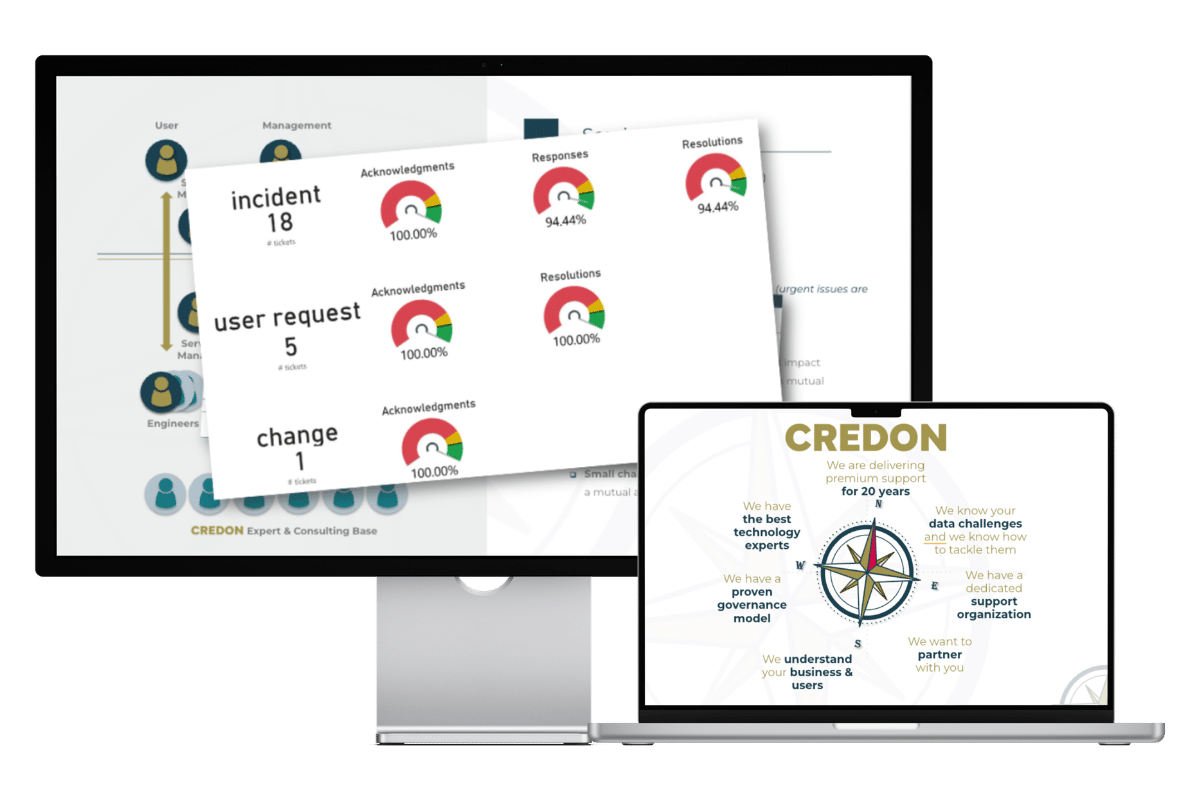
From support to evolution: the service

Operational Maintenance & User Support
Daily monitoring, incident resolution, preventive maintenance and user support to ensure the stability of the environment.
Adaptief & Evolutive Maintenance
Small improvements and adjustments to keep the platform aligned with new data sources, changing requirements and evolving business needs.
Management of the Service
End-to-end coordination of the service by actively managing all of the activities above. This includes monitoring and reporting on the quality of the services delivered through KPI reporting.
Governance that works in an enterprise context
Data Support Factory is designed as a service you can actively steer: measurable through KPIs and managed through a fixed cadence.
Onboarding & knowledge transfer: scope, priorities, points of contact and ways of working are clearly defined.
SLAs and KPIs: clear agreements on follow-up and performance, with reporting through a dashboard.
We do more than monitor. We help steer the ship.
- Operational: continuous follow-up of tickets and KPIs
- Tactical: quarterly review of trends, improvement points and optimisation opportunities
- Strategic: annual alignment on risks, direction and roadmap
Support with ownership: we identify, prioritise and resolve issues within the agreed service framework, and report on this transparently.
Fixed points of contact and continuity: you work with named engineers, supported by a service manager and engagement manager as fixed points of contact. With backup coverage, someone who knows your context is available 250 working days a year.
Why Credon
Credon has been delivering support in data environments for more than 20 years. For us, governance and service procedures are therefore not a new initiative, but an approach that has been in place and refined for many years.
We combine deep technology expertise with a strong affinity for reporting and business users. This allows us to recognise issues faster: what may be a first for you is often something we have already seen and resolved before.
We also have the capacity to support these environments sustainably, and we deliberately invest in long-term collaboration with consistent follow-up and a continuous improvement agenda. Finally, we maintain strong relationships with Qlik and other vendors: we know the roadmap and have direct access to the right contacts, so escalations do not get stuck.

FAQ
For organisations where data and reporting are business-critical, and where support and management need to be organised in a structured way. Typically, this applies when the organisation depends on a single key person, relies on ad hoc support, or needs greater measurability through KPIs.
Data Support Factory is designed for Qlik, Informatica and Microsoft data solutions. Within that scope, we support both data platforms and data intelligence, including advanced analytics, forecasting and AI use cases.
Ad hoc support is often reactive and offers limited predictability. Data Support Factory operates within a clear service framework with agreed service levels, KPIs and transparent reporting, complemented by a fixed governance cadence for steering and continuous improvement.
The service consists of three pillars:
Operational maintenance & user support: resolving issues, preventive maintenance and support for users
Management of the service: prioritisation, follow-up, quality control and governance
Adaptive & evolutive maintenance: small changes driven by updates to source systems, requirements or platforms
We begin with onboarding and knowledge transfer, defining the scope, priorities, points of contact and ways of working. We then define the KPIs and governance cadence, so support is measurable and manageable from the very start.
We typically report on KPIs such as ticket volume, response time, resolution time and trends, for example issue types and recurring problems. The exact KPI set is tailored to your context and priorities.
Prioritisation is based on business impact. This makes follow-up more predictable and ensures that the most important issues are addressed first.
No. In addition to operational support, the service also includes management, follow-up, quality control and small evolutions, so your environment stays aligned with changing needs and systems.
You work with named engineers, supported by a service manager and engagement manager as fixed points of contact. With backup coverage in place, someone who knows your context is available 250 working days a year.
Yes. Credon has strong relationships with Qlik and other vendors, knows the roadmap and can engage the right contacts more quickly when escalation is needed.